For nine months, part time, I managed a French start-up’s app, built by an agency in Vietnam and already six months late.

The founder
in France, not from tech

Me
project manager, the bridge

Five developers
an agency in Vietnam
Founder and team: stock photos (Pexels).
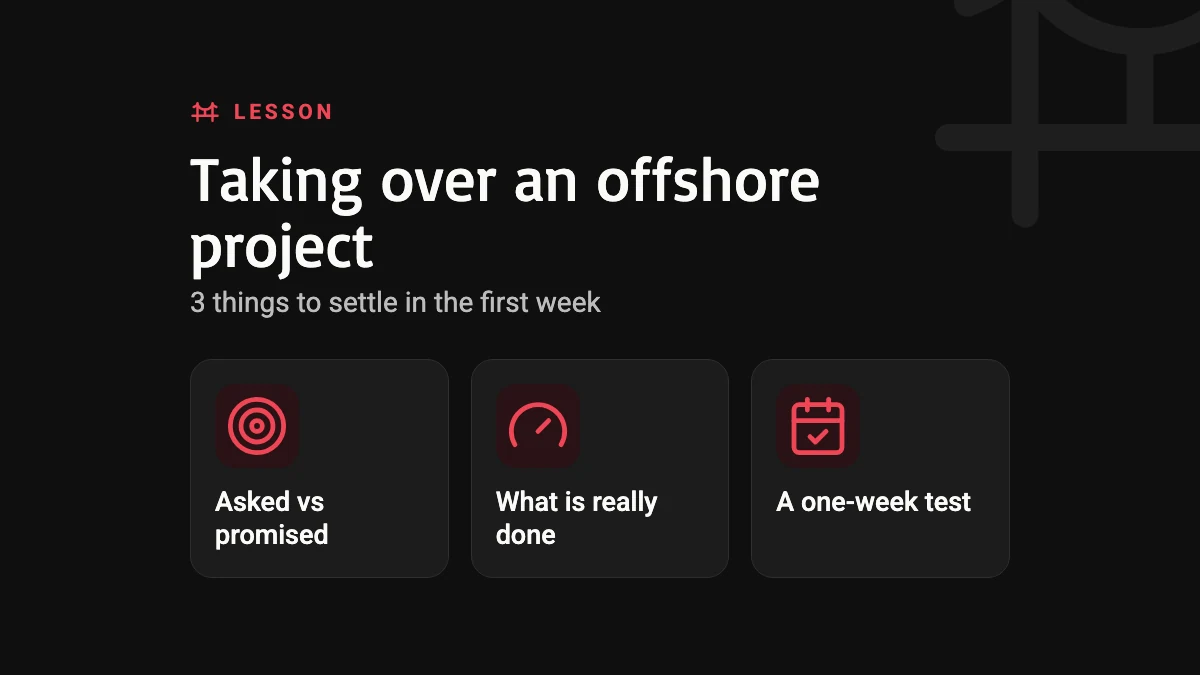
It was one of the biggest lessons of my career. When you take over a project that is already running, three things must be on the table in the first week, the first month at the latest. Be uncompromising: if one of them exists nowhere, or one side does not understand it, it comes before anything else.
1. What was asked, and what was promised
Start with the initial request: the brief, the scope, what is in and what is out.
What France asked for
the brief, the scope, what is in and out
What the tech team promised
what it said yes to, and by when
If the project drags, or if either side is unhappy, the cause is often here: a brief too big, too vague, or never understood by the people building the app. That part starts again from zero.
2. What is really done, and what each side believes
Next, the real state of the work: what is done, delivered and tested, and what is still in progress. I ask the team in Vietnam what they produce every day, and I compare it with what reaches the founder in France.
15 min
Can both sides give me the same picture of the project in less than 15 minutes?
- Yes: on to the one-week test.
- No: we have a big problem.
When the answers don’t match, three, four or more people are working hard on the wrong tasks: they don’t see what blocks the French side, and France doesn’t understand what is going on. Finding out what makes each side unhappy takes two very hard weeks of meetings, sometimes an intense month, and it can end the relationship if no way out is found.
3. A one-week test
Last, one small ticket that the team in Vietnam can deliver in a week, and that the French side agrees to test from end to end.
STEP 1
Pick one small ticket
expected, not blocking, not risky
STEP 2
The team builds it
and delivers it within the week
STEP 3
France tests it
from end to end
STEP 4
You see what gets stuck
teamwork, understanding, capacity
What the diagnosis changes
Together, the three make a full diagnosis. It is the difference between fixing things and consulting, and it sets the tone for the rest of the project with the current team.
It does not have to mean changing the team. It means laying the objectives flat, clear to everyone in two or three languages, then one intensive month with everyone on board: a sound base again, a client who can be satisfied, and a team back on the right tasks, at the right pace.
These three checks are where Offshore under control came from, what I now do with Scale in Peace for founders whose app is built in Vietnam.
Newsletter
Get my next posts by email
One email when I publish something new. No spam, unsubscribe anytime.
Leave a Reply