

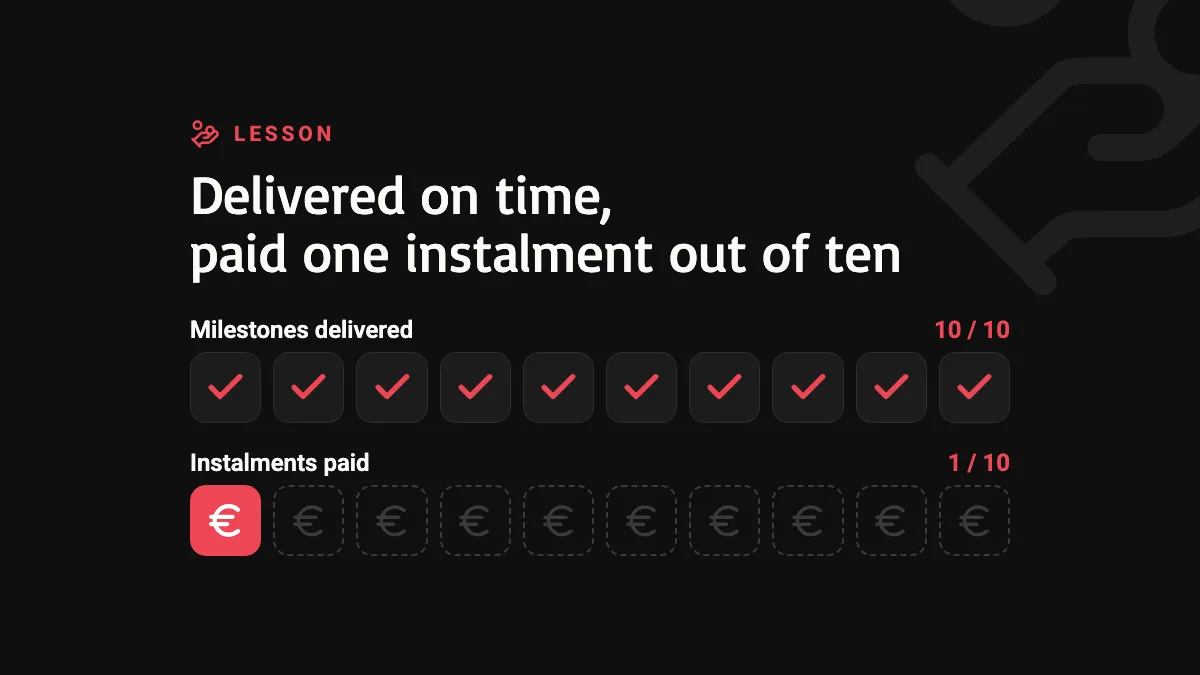
Last winter I managed the build of an estimate tool for a French network of renovation brokers, with a development team in Vietnam. The app went live on schedule, and the team did excellent work. We were paid one instalment out of ten.
I could write about the client. I would rather write about what I let happen, because that is the part I can change.
What I gave first: clarity
The client came with a three-page PDF he called his requirements. What we finally built had almost nothing to do with it.
So I did what you do on an ERP project: I mapped the whole process on Canva. Who does what, when, and how each estimate is created, lives and ends.
I turned that map into a quote, with the business analyst and the designer of the team in Vietnam, who did a very good job. Together they defined the business rules, the data model and every Figma screen, around what the client really wanted. Each time he gave feedback, we corrected it. There were many rounds.
The plan became ten milestones in Notion, each with its tasks, and everyone knew exactly where the project stood. Transparency mattered even more than usual, because every payment depended on a milestone. The client passed what I call the café terrace test©: he could open Notion and see where we were, and we assigned him the tasks that blocked us.
The moment I knew
The deal was simple: one payment for every 10% of the project. The first one was due at kick-off. It arrived more than a month late, after three milestones were already done.
That’s when I thought: wow, OK. The client was slow with his feedback, much slower than the team in Vietnam was moving, and he paid very late.
But a team’s momentum doesn’t stop and restart on command. In this business, being paid at thirty or sixty days is normal, so nobody panicked. The invoices went out, the payments didn’t come, and the project kept going, all of it between Christmas and Tết, with everyone caught up in the rush. I could feel the risk growing. I talked about it. I never said the one word that mattered: stop.
What overtook us
A few months after the launch, I came across a tool doing much the same job, under the client’s own name.
I don’t know how it was built. I have a guess. By late 2025, with Claude Code, Lovable, Codex and the rest, business owners with a freelancer at hand, a bit of resourcefulness or no budget had started building their own tools with an AI coding tool and a few weeks. That is not a bad thing in itself. The client saved about €14,000. On that count, he won.
The irony is that our side used AI too. Everyone does now, though not for everything: our designer drew every screen by hand, and I only started using AI myself in February. The first things I asked it were small tests, to see how robust it was. Replacing a team I was already working with was not among them.
Going around a whole team still takes nerve. And that is a lesson too: some clients see a €14,000 quote and run. Others don’t even dare to run. They say nothing, and they never pay.
What it cost me
For me, the loss is time: weeks of it, holidays included. I can accept that. The trust is harder. Sincerity is one of my core values, and this project went against it. I would rather turn that into rules than into resentment.
What I will never do again
- No deposit, no start. If the deposit is due and unpaid, the team does not start. You have a deadline? Then pay on time.
- The person who validates is the person who pays. Whoever signs off my milestones must have full authority over payments. Two people can share the job if they agree with each other, but I need to know that a validated milestone will be paid. Otherwise we end up with work that is approved and never paid for.
- I stop the team myself. The contract says that when a payment is late, everything stops. And if the team has to stop and restart because of it, the restart is billed, as a surcharge at the end of the project.
- Late payment has a price. I commit to a result and a deadline, and I accept penalties if I miss it. The same goes the other way: pay late, and I apply penalties. Between businesses in France, the law already provides for them, plus a fixed €40 recovery fee per late invoice. Most of us never use them.
- The clarity is paid first. The process map, the data model and the mockups were the most valuable part of this project, and the client had them before the first payment arrived. Now that code costs less every month, that is the part I bill first, on its own.
What failed on my side was the control of the money, and as the project manager, that was my job too. The rest is a question about how tech projects are sold now. Faced with a €14,000 quote, a client can ask himself: if I can build it with three prompts, what am I paying for, and what do I get on top? You can still sell an app at that price. You have to sell it differently, and offer new guarantees. For me, and for the agency I partner with, this project started a deep rethink of how we work.
Newsletter
Get my next posts by email
One email when I publish something new. No spam, unsubscribe anytime.
Leave a Reply